The Texas–Louisiana Gulf Coast is the backbone of America’s energy and chemical economy. Texas produces roughly 43% of U.S. crude oil and 28% of natural gas, while Texas and Louisiana together account for about half of the nation’s refining capacity—processing 9.3 million barrels of crude per day across 50 refineries. The region also produces approximately 80% of the nation’s primary petrochemicals and ships more than $117 billion in chemical products annually from Texas alone.
This unmatched concentration of refining, petrochemical manufacturing, pipelines, ports, and technical talent makes the Gulf Coast one of the most critical energy hubs in the world. But maintaining that leadership in a rapidly evolving global market will require intentional collaboration, faster technology commercialization, and strengthened supply chain resilience.
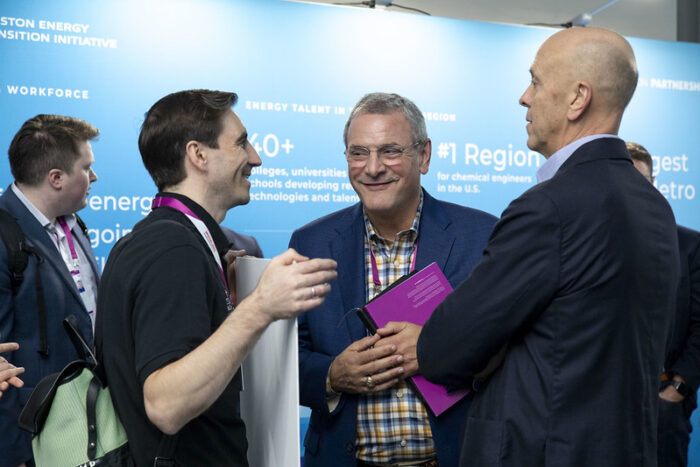
In fall 2025, the Greater Houston Partnership’s Houston Energy Transition Initiative (HETI) convened national laboratories, Gulf Coast universities, and industry leaders to examine how to reinforce the region’s long-term competitiveness. Participants included Argonne, Oak Ridge, Lawrence Berkeley, the National Energy Technology Laboratory (NETL), and the National Laboratory of the Rockies, alongside Gulf Coast academic institutions and energy and chemical companies. A full report on the key learnings and recommendations from the workshop can be found here: https://bit.ly/4uEDEqk
Key Findings and Takeaways
1. Supply Chain Resilience Requires Structured Industry–Lab Collaboration
Resilience—diversity of supply, operational flexibility, and rapid recovery—was a recurring theme. Recent disruptions exposed vulnerabilities in tightly interconnected energy and manufacturing systems.
National laboratories provide capabilities that complement Gulf Coast industrial scale, particularly at early and mid technology readiness levels (TRLs 1–7), before full commercial deployment. Examples include:
- Advanced manufacturing and AI-enabled validation of critical components (Oak Ridge).
- Materials scale-up and techno-economic modeling to move from lab discovery to industrial relevance (Argonne).
- Pilot-scale testing for severe-service alloys, chemical conversion, and process innovation (NETL).
- Integrated energy systems modeling to assess grid resilience and system disruptions (National Laboratory of the Rockies).
Recommendation: Organize targeted Gulf Coast industry missions to national laboratories focused on critical supply chains—power equipment, high-heat industrial processes, novel catalysts, refining, and grid infrastructure—to identify joint development opportunities and reduce time to commercialization.
2. Modeling, AI, and Open-Access Platforms Can Bridge the Technology Gap
A persistent barrier to innovation is the gap between scientific discovery, applied development, and commercial deployment. Universities often operate at TRLs 1–3, national labs at 1–7, and industry at 7–9. Bridging these silos requires shared modeling tools, high-performance computing, and structured feedback loops.
National labs maintain open-access platforms capable of:
- Simulating grid expansion, investment, and dispatch decisions.
- Modeling cradle-to-gate industrial material flows.
- Optimizing complex energy and chemical systems.
- De-risking carbon capture, critical mineral recovery, and advanced manufacturing integration.
Recommendation: HETI should convene structured training and feedback sessions on these public modeling platforms—ensuring Gulf Coast industry can apply, improve, and help guide further development of tools critical to regional competitiveness.
Federal initiatives such as the Genesis Mission, focused on AI-accelerated scientific discovery, further expand opportunities for Gulf Coast participation.
3. Time to Commercialization Is the Ultimate Competitive Metric
The lithium-ion battery is a cautionary example: while pioneered in U.S. labs, large-scale manufacturing leadership shifted overseas. Without strategic intervention, U.S. firms are projected to capture less than 30% of domestic lithium battery cell value by 2030.
Successful DOE-backed consortium models show that mission-aligned, multi-partner collaboration reduces development timelines and strengthens domestic manufacturing know-how. However, public–private partnership mechanisms such as CRADAs and Strategic Partnership Projects can be time-intensive.
Recommendation: The Gulf Coast should actively engage DOE and national laboratories to streamline public–private partnership pathways, improve intellectual property clarity, and expand industry access to laboratory infrastructure.
The Path Forward: A Gulf Coast Consortium Model
The workshop’s central conclusion was clear: the Gulf Coast should formalize collaboration through a regional industry–academia–laboratory consortium.
Such a model could:
- Co-locate national lab researchers within the region.
- Share modeling data and analytical capabilities.
- Establish open-access pilot facilities that complement lab infrastructure.
- Harmonize IP frameworks to accelerate licensing and deployment.
With its dense industrial ecosystem, technical workforce, and decision-making concentration, the Gulf Coast is uniquely positioned to serve as a national demonstration hub for advanced energy and chemical manufacturing.
If industry, universities, and national laboratories align around a shared regional strategy, the Gulf Coast can:
- Accelerate commercialization timelines.
- Strengthen critical supply chains.
- Unleash a world-class technical workforce.
- Reinforce U.S. leadership in strategic energy and chemical sectors.
HETI and its partners are committed to advancing this collaborative model. With deliberate action and sustained partnership, the Gulf Coast can remain not only the nation’s energy anchor—but also its proving ground for the next generation of global industrial leadership.